
Over the 98 years that the Academy Awards have been held, there have been significant changes in how people perceive the roles people of different races and genders can play in film, and thus, the distribution of who wins the most prestigious awards in film has also shifted. But how big have these shifts been? And do they appear to be long-term? Our project aims to understand the distribution of race, gender, and country across Oscar ceremonies over time. We believe that because the Oscars are the highest stage for film, the trends that we will see reflect a broader perception of who belongs in film and where the industry stands in terms of accepting diversity. More specifically, we test whether changes in winner demographics look sustained across decades or whether they appear as short-lived spikes motivated by backlash from advocates of diversity that are then followed by plateaus. Through a Kaggle-provided dataset, which scrapes the Academy Awards database up to the 2020 ceremony, we look broadly at how changes in racial, gender, and age distributions across categories of Best Actor/Actress awards, behind-the-camera awards, and the distribution of winning countries of the Best International Film award have appeared over time. These analyses, paired with our extensive deep dives into the existing literature surrounding film and award shows, allow us to draw far-reaching conclusions about how the diversity of the Oscars has changed over time and what direction it is headed.
As seen from many movements and campaigns started by the public, including the prominent #OscarsSoWhite movement in 2015 that called the Academy Awards out for not nominating a single actor or actress for an award, the general public seems to believe the Academy Awards are a reflection of deeply rooted industrial gatekeeping that privileges white men (Bregel BBC Article). It’s been nine years since #OscarsSoWhite took the internet by storm, yet authors such as Raffi Sarkissian, who wrote “‘To Hell with Dreams’: Resisting Controlling Narratives through Oscar Season” argue that while movements and increased pressure have sparked some progress that has led to more diversity in nominations and wins across the board, there are still overarching worries that this progress is more like a short-term performative move than a genuine one, and there are still systemic barriers within the production side of film that still have not been addressed (Sarkissian, 3-4). Research analyzed by author Pablo Peña also shows that there is a prevalent double standard when it comes to age, where men’s ages are never a barrier to them winning awards, while women’s success remains tied to their youth (Peña, 3). The main question that has not been answered is this: will the Academy’s recent trend in diversification lead to long-term structural parity, or will diverse winners still be the exception in a world of white men?
Most broadly, the purpose of our Digital Humanities project is to understand the shifts in diversity of Oscars ceremonies throughout the years to determine whether there has been reliable change from its beginnings as a platform primarily for old white men. By quantifying these shifts, we can uncover trends and patterns to see the progress, or lack thereof, of representation in the Oscars. We want to find out whether changes in representation are sustained over time, so that we can help others understand how cultural prestige is produced and maintained through awards.
How Have Race and Gender Distributions Changed Over Time for Acting Awards?
In thinking about representation at the Oscars, we can start by analyzing diversity changes in the Acting awards, namely Best Actor/Actress and Best Supporting Actor/Actress, as those are the individual awards that receive the most public attention. The changes in gender and racial distribution of winners in these categories often signal overall changes in the industry.
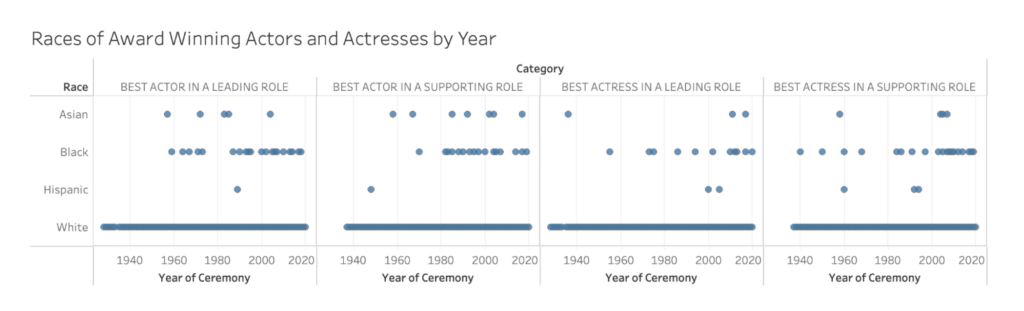
This visualization shows that while white actors and actresses have been winning the Oscars for Best Actors and Actresses in leading and supporting roles, minority races have only started seeing increased representation relatively recently. Prior to 1960, it appears that fewer than five minority actors or actresses won these awards in total. Starting in the 1960s, Black actors started to see a surge in Best Lead Actor wins, although they did not see a similar trend for Best Supporting Actor until around 1980. However, it is clear from the visualization that wins are becoming more common between the period of 1980s-2020 for Black actors and actresses than before, indicating a relatively recent increase in recognition for their work. Meanwhile, across the board, Hispanic actors and actresses have the lowest representation in wins, with Best Supporting Actor not won by a Hispanic man since around the 1950s. This then shows that diversity efforts have not been helpful for Hispanic people, as there is no obvious upward trend in Hispanic representation in Oscar wins. Asians also seem to win awards rather inconsistently, though all seem to have some relatively recent wins. We are curious to dive deeper into whether these results are a reflection of a lack of meaningful roles in Hollywood for minorities or snubbing at the nominations stage.
How Has Race Distribution in Oscar Wins Changed Over Time?
While our previous visualization shows race and gender distribution of Actor and Actress awards specifically, we can also zoom out to look at race distributions in Oscar wins overall to see whether this proportion stays true. One might assume that there wouldn’t be such a marked difference between white and minority wins when other categories are added to the mix, given that the popularity of actors and actresses requires public support, which has, in the past, most readily favored white people, while other categories are largely not public-facing. But what do the results show us?
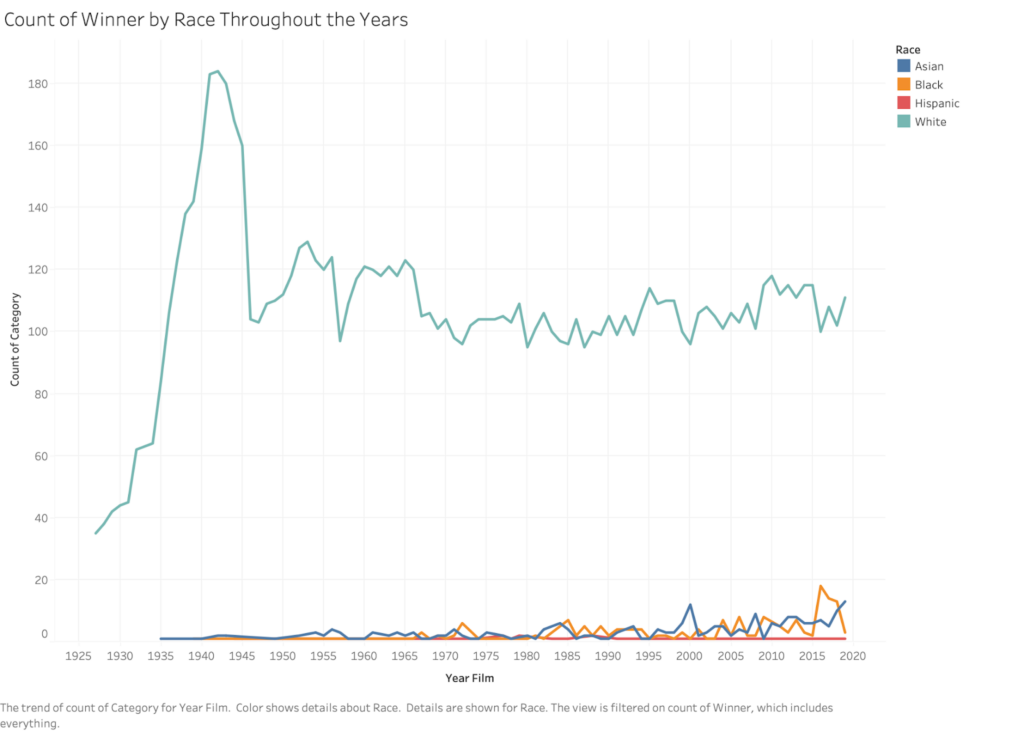
From this graph, we can see that the trends from our first visualization remain true even when the data is widened to include non-acting roles. This shows that even in roles that aren’t so explicitly public-facing, white people are still taking home the vast majority of wins, skyrocketing far above the lines of any minority. We can also see that the largest peaks for Asian and Black winners occurred at or after 2000, showing that the recognition minorities are getting has been relatively recent and not necessarily stable, given that their win numbers still fluctuate throughout time. Meanwhile, as we’ve seen with the previous graph, there is still next to no Hispanic representation in any Oscar wins.
Perhaps this continuing trend of minorities receiving very minimal recognition in the Academy Awards, even when broadened to include all possible categories, is most likely a reflection of enduring societal structures and industry barriers that make it difficult for minorities to break into, let alone make a name for themselves, in film. Additionally, the very clear lack of minority representation historically could be a very strong deterrent for minorities who would otherwise consider going into the film industry, which is another very important possible explanation for the lack of minority wins at the Oscars.
How are women represented in wins behind the camera?
We can now start transitioning to look specifically at gender diversity in non-acting categories, which are also extremely important. Historically, the entertainment industry has made it easier for men to break out in behind-the-camera roles such as screenwriting as a result of men occupying higher roles in the industry at higher rates and thereby controlling what stories get told (Bielby & Bielby, 250-252). We are very interested in seeing how, if at all, the industry has changed to welcome more female perspectives in all roles within film that don’t encompass acting.
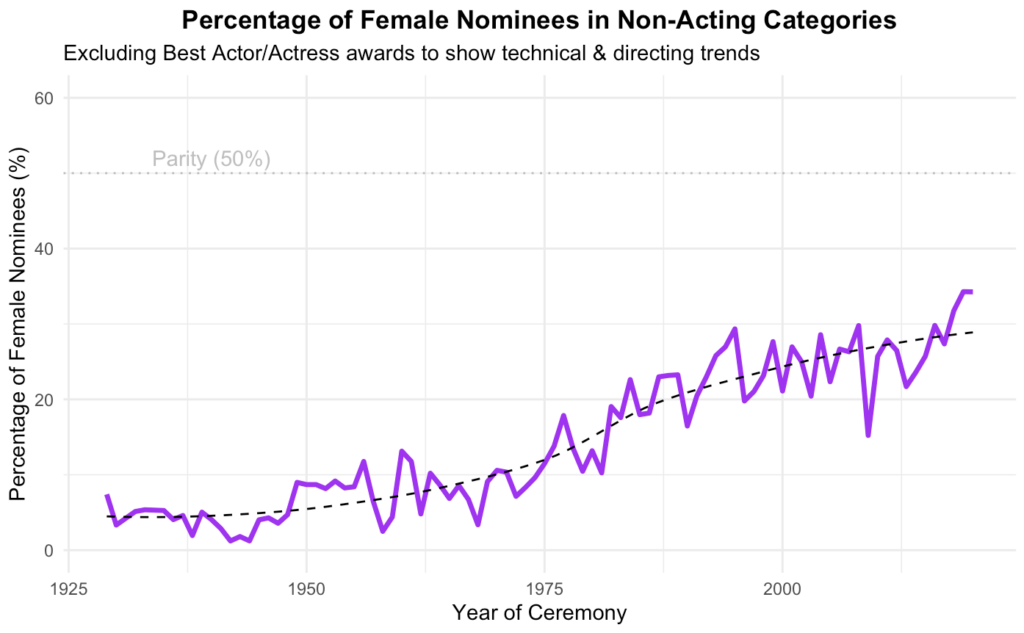
This line chart shows the percentage of women (excluding best actress/actor) who have been recognized at the Oscars since the ceremony’s inception. As we can see, there has been a general uptick in women’s representation throughout the years, with a large improvement from under 10% in the late 1920s to now sitting at around 35% today. However, the 35% we see today is still far below the 50% mark we would expect to see if recognition across genders were truly equal.
This line chart is important for our research as it shows that while there is clearly an attempt, as well as an improvement, in the Oscars trying to be inclusive toward women over the past century, it is still missing the mark. However, this begs the question: Is the Oscars not doing enough to recognize women’s achievements in the industry, or is the shortage of women winning awards in film a result of a larger issue in Hollywood, where production companies may not be hiring enough women or giving them a chance to have their visions unfold on the screen? This is an important distinction. If it is the former, it would be a reflection of the Oscars’ own biases. But if it’s the latter, then the Oscars are simply a reflection of the deeper roots of inequity in the industry it represents, and let us argue that structural policies might potentially need to be implemented in order for things to truly change.
What is the Age Distribution of Oscar Winners?
An important, yet often overlooked, dimension of representation in the Oscars is the age of acting nominees. While much attention has been given to race and gender, age can reveal additional biases in how the film industry rewards performers。 Analyzing awards by age can illuminate these biases.
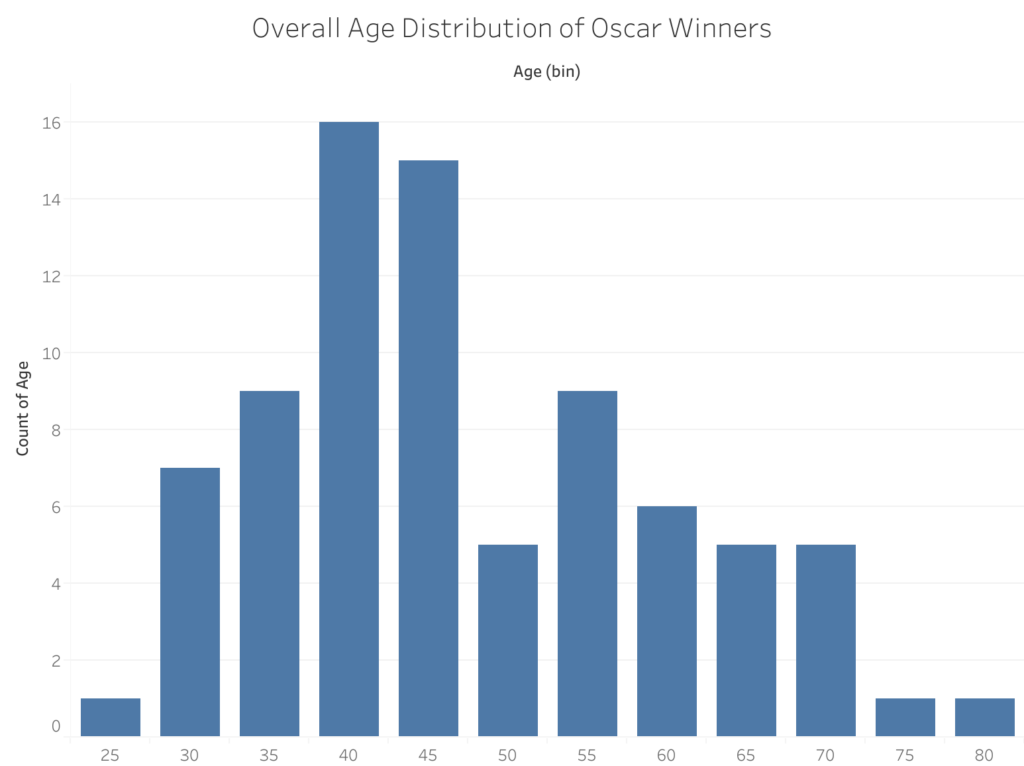
In this histogram, we can see that Oscar winners have the highest concentration at around the ages of 40-45, while there is very, very low age representation for the youngest and oldest categories. This suggests that recognition by the Academy may favor certain stages of life more than others. The low number of young winners could be a reflection of a lack of experience or the difficulty of breaking into the industry early, while the low number of winners at older ages could reflect retirement or a stigma around older people in the industry.
how does age shape Academy Award Success by Gender?
Are men and women recognized at the same stages of their careers, or do expectations differ across genders? This visualization explores the age distributions of nominees across the four acting categories: Best Actor, Best Actress, Best Supporting Actor, and Best Supporting Actress, providing insight into how age and gender influence the determination of success by the Academy’s standards.
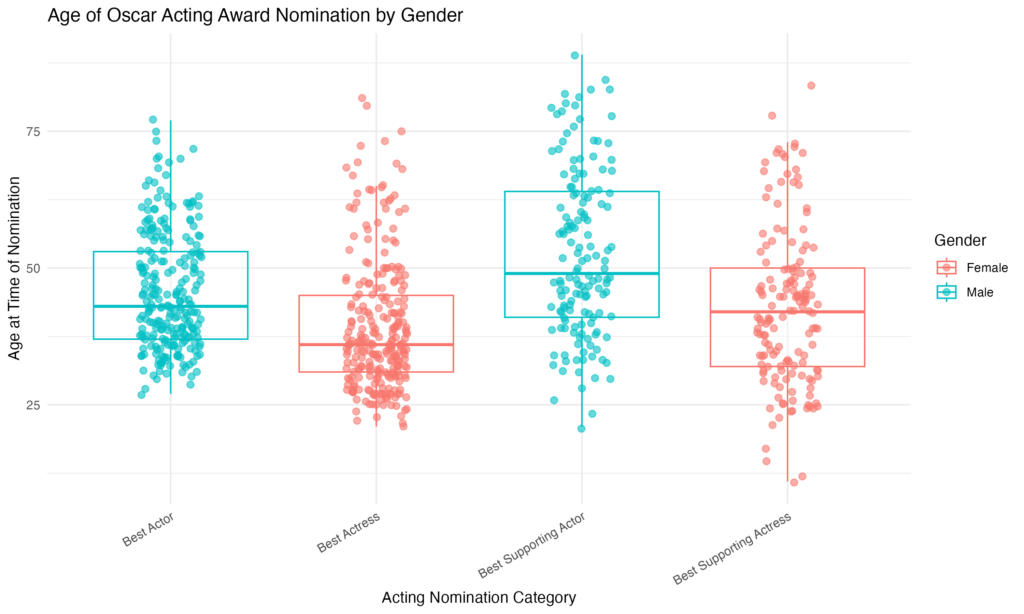
The plot shows a clear and persistent pattern: male actors tend to be older than female actors when they are nominated for Oscars. In leading roles, the median age of Best Actor nominees falls in the late 30s to early 40s, while Best Actress nominees are typically in their early to mid-30s. This discrepancy remains consistent in supporting categories, though both men and women skew slightly older: supporting men receive nominations in their late 40s and supporting women in the mid to late 30s. Overall, men benefit from a wider age window for recognition, while women’s success is more directly tied to youth.
These patterns reflect broader cultural and industry norms within Hollywood. Male actors tend to be celebrated for experience, gravitas, and mastery of their craft, with older performers cast in roles that highlight wisdom and authority. Female actors, by contrast, face systemic pressures to maintain physical attractiveness and youthful appeal, which can constrain the types of roles available and the timing of recognition (Alexandra-Ramona, 139). Age thus becomes an additional axis along which gender disparities are reinforced, sharpening perceptions of who can succeed and when. By quantifying this difference, this visualization highlights an often invisible layer of inequity in the film industry, complementing the analysis of race and gender in Oscar wins, and providing context for why representation remains uneven across multiple dimensions of identity.
Which regions are most represented in International Film?
The Best International Feature Film category of the Oscars Academy Awards, which first started in 1947 under the title Best Foreign Language Film, was first introduced after films transitioned from silent to predominantly having dialogue. An analysis of which countries have historically won this category can help us see potential biases in the Oscars toward certain countries, as well as how different countries view film as a transmission of culture.
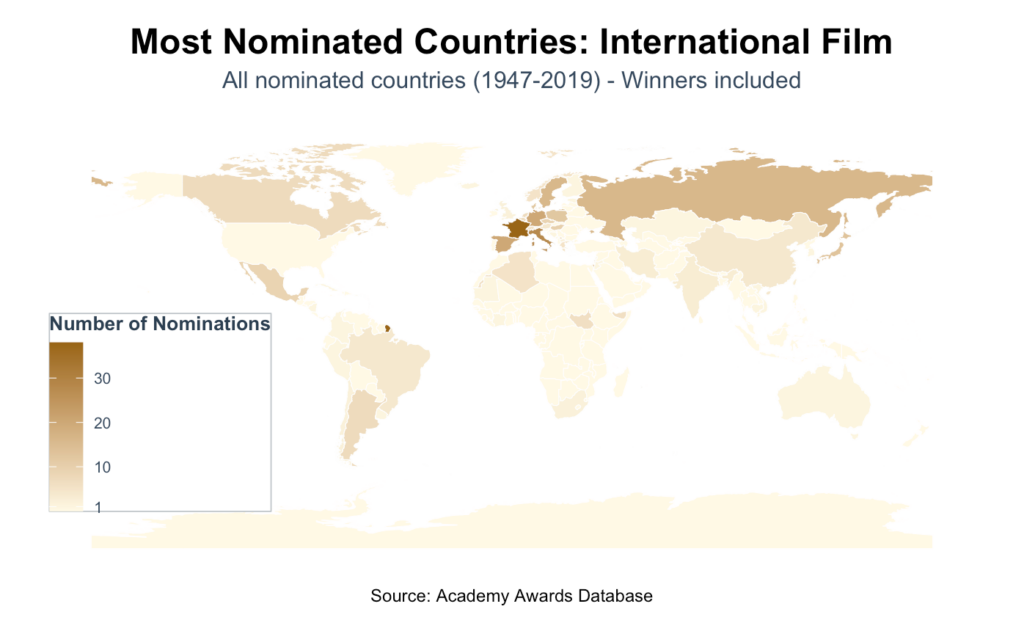
This map of nominations by country shows that nominations and victories were predominantly awarded across Western Europe, most notably in Italy, France, and Spain. This highlights the historical dominance and potential bias of the Oscars toward Western, mainly white, films. This representation is significant because it shows the viewer how cultural recognition often correlates with a country’s funding and infrastructure. Knowing the distribution of countries winning these awards can give us a lot of insight into which countries value film as an industry and invest resources into winning these awards, and because film is entertainment and entertainment is highly considered a luxury, it also tells a story about economic disparities across countries.
Furthermore, the lack of any nominations among a lot of the countries in the Global South and Asia as a whole also supports a correlation with what countries are widely considered “first world,” having more winners, which implies that countries with more winners value film more highly. It can then be assumed that these countries disproportionately have the wealth required to consistently produce movies that win awards and also choose to use that wealth in that way.
Conclusion
Ultimately, the patterns that we see in acting and behind-the-camera awards, as well as international film recognition, all point towards one thing: the Academy Awards are not an all-encompassing arbiter of excellence, but rather a mirror that reflects the inequities that plague the film industry. Racial and gender disparities in nominations and victories are not random, but instead are the downstream result of who gets prioritized when it comes to who gets cast, hired, funded, and whose stories are deemed to be “worthy” enough to be told.
There have been signs of progress, as minority representation in the Oscars has grown somewhat in recent years. However, as long as the structural foundations of the film industry remain the way they are, the Oscars will still mirror those structural inequities. Things such as unequal hiring practices, gatekeeping in funding, and the silencing of stories deemed too “risky” for the general public by those in power will continue to prevent the Academy Awards from becoming the true representation of cinematic excellence.